
Introduction
PureCount's inventory counting system was stuck in the past, counters carried laptops in backpacks to do manual data entry on warehouse floors, a process that was slow, error-prone, and physically awkward.
I led the end-to-end design of a modern replacement: a voice-enabled mobile app for counters and a web-based admin platform for count managers. Over 6 months I ran the full process across both desktop and mobile.
Key achievements
Successfully developed and integrated voice recognition capabilities
Turned numerical data into an intuitive and user-friendly software
Modernized a legacy system into a mobile app
Research
Understanding users through deep discovery
I started with a pre-discovery survey to understand user needs, then ran competitive analysis of existing inventory solutions to understand what the market had already solved.

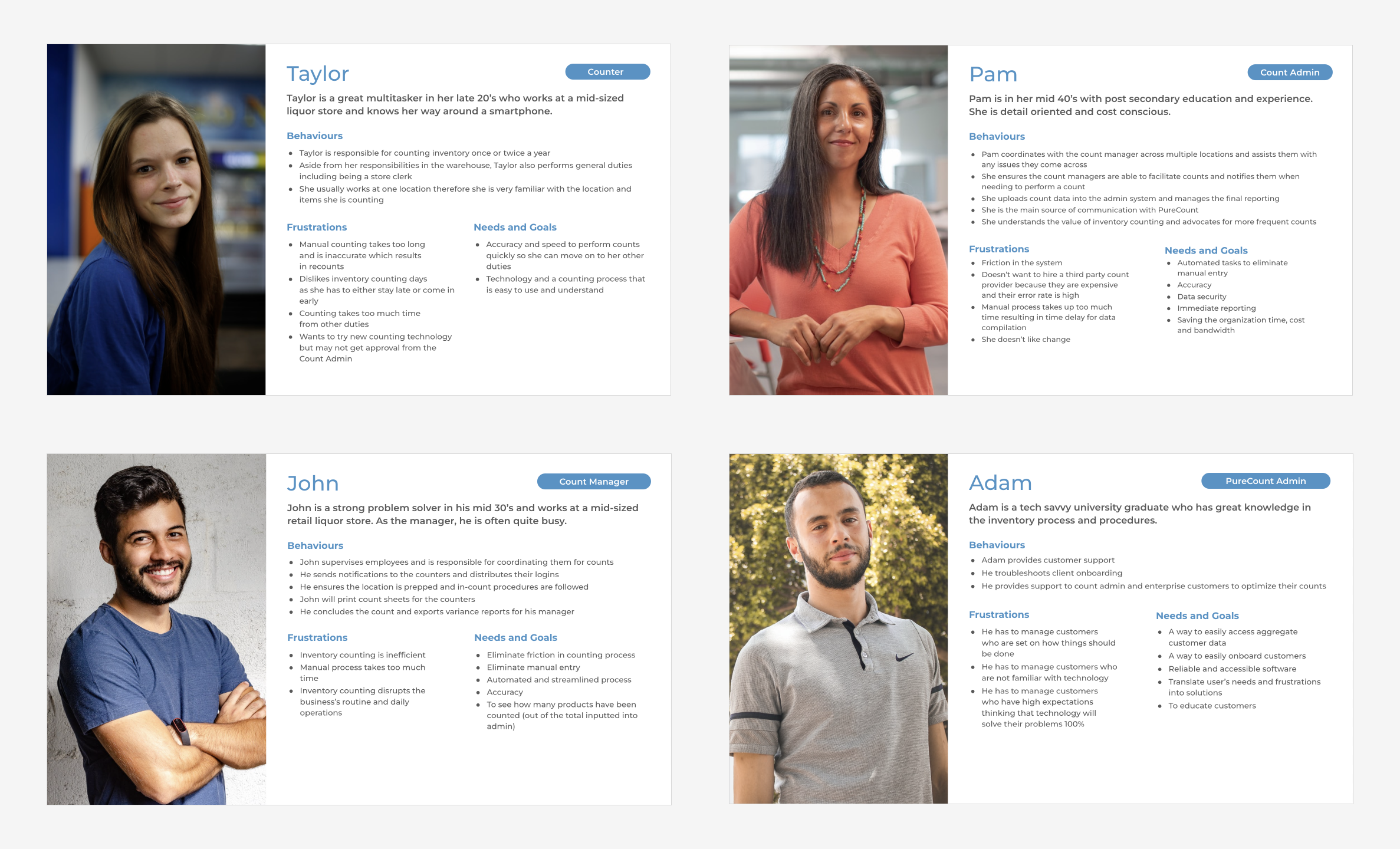
From discovery, we identified four distinct user types, from Count Admin down to the Counter, who all shared the same core frustrations: manual processes and high error rates. The counting workflow had too many steps, too much room for human error, and no way to move at speed on a warehouse floor. This validated the core direction which was voice recognition to eliminate manual entry, and a guided mobile interface to reduce errors without slowing counters down.


Iterations
Crafting a human centered experience
I began with creating low-fidelity wireframes for both the desktop and mobile app. In the mobile app, I prioritized the voice recognition feature to enable developers to test these core functionalities in their intended environment. This was probably my favourite feature to design because I had full creative freedom over the interface and I had fun designing the different states of the voice recognition with icons and micro-animations. For the admin dashboard, I focused on count management as the platform's core feature, giving managers visibility into active counts, variances, and more without requiring them to dig for information.

I then conducted moderated usability tests with five participants, each completing five different count management tasks using Figma prototypes. The goal was to validate the system's usability, given the multiple steps users needed to complete during the counting process. The user testing revealed that despite the platform's complexity, participants found it easy to use and informative. They noted that the button placement and design clearly guided their actions, however some uncertainty in some tasks stemmed from the user testing instructions.

Outcomes
Transforming inventory counting for the modern era
To complete the project, I applied the brand guidelines to the wireframes to ensure visual consistency throughout.


The project was delivered in full and ready to be released to the market. However, the clients did not proceed due to internal business decisions made after the engagement concluded.
Reflection
Lessons learned along the way
Scope creep is a discovery failure as much as a planning one. When the client identified missing features during wireframing, it pointed to gaps in the initial discovery process and meant real consequences for timeline and budget. I now make sure to capture edge cases and essential functionality as early as possible.
Working with complex numerical data and logic flows was both challenging and rewarding. The complex variance logic required thorough analysis of multiple scenarios, helping me develop my analytical thinking skills.